
Research Purpose and Questions
Study Purpose and Research Problem
Research suggests that improving school administrators’ competence through training and on-the-job support can lead to lower turnover rates, enhanced organizational effectiveness, and better student outcomes. While there are several approaches to on-the-job development, coaching is the most widely used method. However, despite its prominence, empirical research on coaching’s effectiveness remains limited across various sectors, with few studies demonstrating its ability to produce sustained behavioral change or improve organizational outcomes (Boysen-Rotelli, 2020; Hofmans, 2018; Nielsen, 2020; Offstein et al., 2020; Rekalde et al., 2017; Vaisben, 2018; van Nieuwerburgh, 2016; Wise & Cavazos, 2017).
Despite its wide usage, research on the effectiveness of coaching for administrators is limited. This study sought to fill that gap in understanding and impact.
In Adventist education in North America, coaching has not yet been formally adopted as a system-wide tool to support school administrators, Nielsen’s (2020) study was the only one found on its use as of 2024.
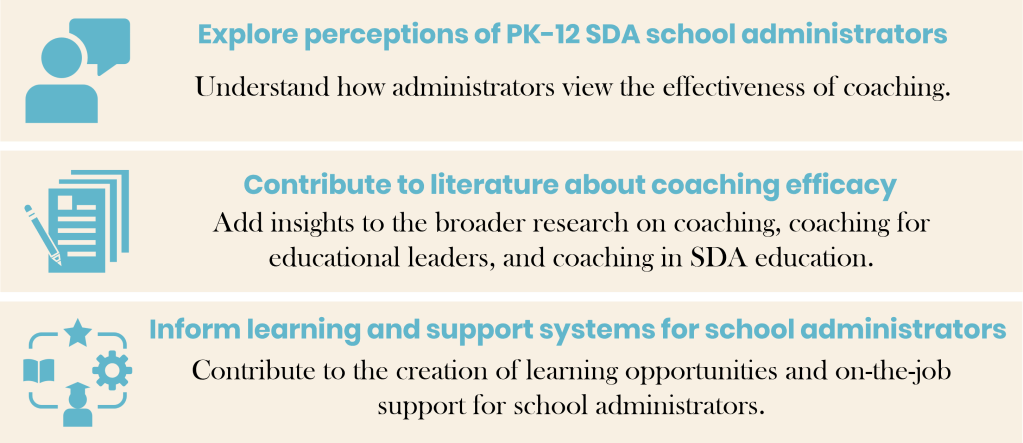
The primary goals of this study were to contribute to research and practice in the following ways:
Research Questions
- What are PK–12th-grade Seventh-day Adventist school administrators’ perceptions of the effectiveness of coaching in developing their leadership behaviors?
- How do PK–12th-grade Seventh-day Adventist school administrators perceive coaching has influenced their ability to better achieve organizational-level goals?
- What are PK–12th-grade Seventh-day Adventist school administrator perceptions about which leadership behaviors are the most important to focus on when receiving coaching?

 Amy's Assessment