
Using the New World Kirkpatrick Model to Assess Coaching Effectiveness
The New World Kirkpatrick (NWK) model, a widely used framework for evaluating the effectiveness of training programs, was the conceptual framework my study. This model is commonly used across business and education sectors to assess how well training helps individuals grow and achieve organizational goals.
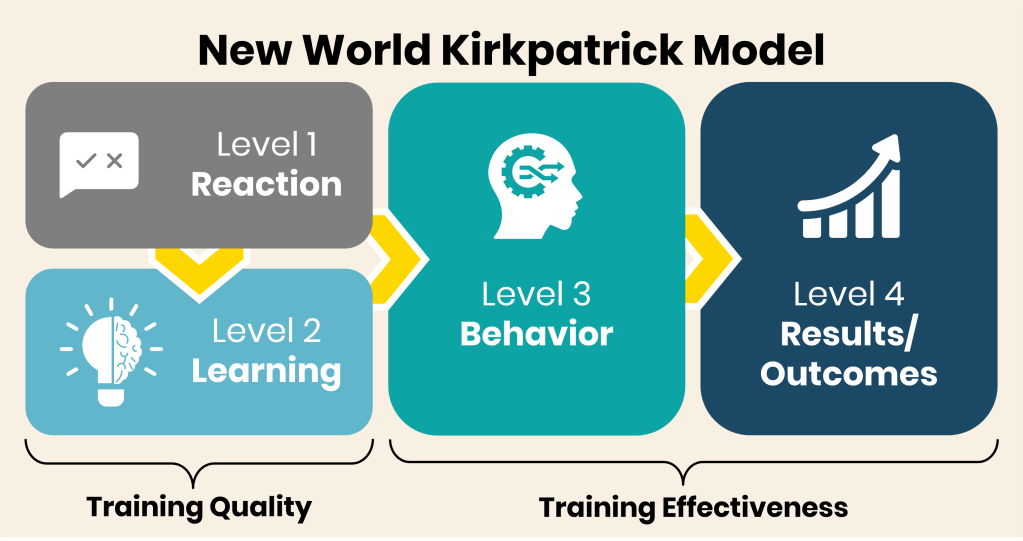
The model consists of four key levels to evaluate training quality (Levels 1 and 2) and training effectiveness (Levels 3 and 4):
- Reaction – This level examines participants’ satisfaction and engagement with a training experience.
- Learning – This level assesses whether participants gained new knowledge, skills, or confidence through a training experience.
- Behavior – This level examines participants’ behavior change and on-the-job application of what they learned from a training experience.
- Results – The final level examines benefits to broader organizational outcomes resulting from participants’ training experience.
My study and research questions specifically focused on exploring the effectiveness of coaching in developing leadership behaviors and achieving organization-level goals, which aligned with Levels 3 and 4 of the NWK model. However, the rich data provided by participants connected to all four levels of the model and offered a holistic understanding of the participants’ perceptions of their experience with on-the-job coaching.
Participants’ feedback both highlighted the quality of the coaching experience and demonstrated the effectiveness of coaching in achieving behavior change and supporting organizational goals.

Participants found the coaching sessions enriching and beneficial. Many described their experience as a “good experience” and expressed feeling valued, heard, and encouraged. The confidential and non-judgmental environment was particularly appreciated, as it allowed them to be vulnerable and grow as leaders. However, some challenges were noted, such as limited time and availability for coaching sessions, especially during the COVID-19 pandemic.
Participants felt valued, heard, and encouraged in a confidential, non-judgmental environment.

Participants gained important strategies and skills in areas they had received no prior training: managing conflict, planning strategically, communicating with diverse groups, and implementing teacher coaching systems. They also recognized the importance of embracing uncomfortable leadership challenges, improving delegation, and leveraging their personal strengths.
Participants identified the need for more training in areas like school law, finance, and change management, which could better prepare aspiring administrators for their roles.
However, participants identified gaps in their training and highlighted additional areas where further learning was needed: school law, finance, change management, communications, talent management, facilities management, Adventist education policy, safety, and marketing. Many felt that this foundational training should be provided to aspiring administrators before they take on their roles.

Coaching led to noticeable changes in leadership behavior. School administrators become more confident, mindful, and intentional in their leadership practices. One notable outcome was their adoption of a coaching stance with their teachers and staff. This change empowered teachers, improved delegation, and fostered stronger relationships within the school community, leading to increased confidence and initiative among staff.
Coaching helped administrators become more confident and strategic, with the most notable theme being their adoption of a coaching stance to empower teachers and staff.

While direct impacts on student outcomes were limited, the coaching contributed to a positive shift in school culture, which participants identified as a key factor in organizational success. The changes in leadership behaviors led to an improved school environment, ultimately supporting broader organizational goals.
Improved school culture, a critical element for organizational success, was a key outcome of coaching.

 Amy's Assessment